
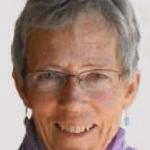
From time to time. PRT will be highlighting people who deserve recognition for their work on behalf of the community.

“Journey Stories,” the Smithsonian Museum on Main Street Exhibit that opens at Cady Hall on January 4, is being presented in selected towns and cities throughout the United States, and it is coming to Patagonia because of the efforts of Abbie Zeltzer. After applying to the Arizona Humanities Council to be part of this project, Zeltzer began more than a year of planning and fund-raising, wrote four grants, rounded up volunteers, and organized all the pieces of this multi-faceted event while also overseeing the daily ebb and flow of the library.
Those who know her are not surprised. “Abbie’s enthusiasm for the Museum on Main Street project is contagious. Her knowledge of local resources and relationships has enabled her to pull together a diverse line-up of activities throughout the six weeks,” said Paisley McGuire, who is heading up the docent volunteers. Lynn Davison, another volunteer, is impressed by Zeltzer’s fundraising ability and her broad community vision for the library.
Here then is Abbie Zeltzer’s Journey Story.
If you have an ear for voice inflection, it’s not hard to guess that Abbie grew up somewhere near New York City. In fact, she was born in Brooklyn and spent most of her teenage years in a Long Island suburb. She spent summers in the Catskill Mountains and believes it was there, digging in her neighbors’ vegetable garden, that she saw her future as a farmer. She was accepted at the University of Arizona to study plant pathology, and on the last day of high school she left home and moved to Tucson. One autumn day several years later, she visited Patagonia and fell in love with the town. Says Zeltzer, “I knew then that I wanted to live here.”
After graduation, her first job with a plant scientist brought her in contact with Steve Taber, a bee expert who took one look at her, declared her a beekeeper and said, “Come with me!” That encounter took Zeltzer into a whole new world, and she became a bee expert, managing colonies for scientific experiments and studying the mating habits of these small creatures. Her expertise in this field opened up new doors, and she traveled extensively in the United States and South America, tracking down and studying the spread of Africanized bees (known popularly as “killer bees”).
And then, one day, she heard about John Bradsher, a beekeeper who needed help and just happened to live in Patagonia. Soon she had started her own business in town, Sweetwater Apiaries. The profits were slim, and Zeltzer recalls vividly how hard she worked to make a go of it. She baked, grew and canned her own food, and cut back on everything so she could stay here. Jobs opened up from time to time—librarian at the Patagonia High School and later at the elementary school, teaching reading in Elgin and at The Little Red School House. And then she did more traveling—consulting about bees in California and Florida, and more trips to South America. This period of her life, says Zeltzer, is “all a moosh” in terms of dates. One memorable episode involved backpacking around South America with another bee expert, just following the trail of bee-keepers without a schedule and without pay.
Then, back in Patagonia, her hives were wiped out two years in a row by bears. Without the resources or much energy to start up again, she decided to go back to school and get a master’s degree in Agricultural Education. Her thesis was on the educational needs of beekeepers.
In 1994, shortly after earning that degree, she was hired as the Patagonia Library Director. When Zeltzer took over the directorship, the library was housed in two rooms and was struggling. Four years later, Patagonia had to declare bankruptcy and decided to close the library. Rather than let this happen, The Friends of the Library took over and managed to keep the doors open. Zeltzer decided to go back to school.
In 2004, she came back to her job with a Master’s degree in Library Science. During the five years that she was gone, she interned with the Bill and Melinda Gates Foundation in a program for tribal libraries, with a focus on technology. She also trained at the National Archive Institute in Washington D.C. Being immersed in historic national documents, she recalls, made her realize that Patagonia was in danger of losing its history.
Since her return, she has devoted her energies to the library by writing grants, gathering enthusiastic volunteers, and cajoling lots of donors. Zeltzer has been part of the restoration of Cady Hall and the addition of two reading rooms. With help from volunteers, she has overseen the landscaping of a garden filled with legacy plants. The library collection is computerized and the library is the hub of interconnection in the town. Children are always there, adults hold meetings, people pick up their Fed Ex parcels, the computers are always in use, seniors come in to read the paper and chat, and well behaved dogs get treats.
Her fear that Patagonia might lose its history has been alleviated by the energy of the Patagonia Museum supporters and with the flurry of research and documentation that are a result of the Journey Stories.
If we go way back to the garden in upstate New York where Zeltzer first thought about being a farmer, her journey seems to have landed her closer to a bookshelf than a tractor, but the job of farming—planting seeds, working in community, cultivation, diligence, getting through hard times, and celebrating the harvest—are all part of what Zeltzer brings to the library and Patagonia as a whole.