
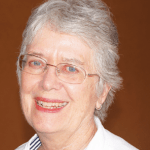

Luz Rabago Valenzuela (1858-1909) and her husband Valentine had eleven children (six boys and five girls). Luz was born in Mexico in 1858 and arrived in Arizona about 1880, with her mother, Guadalupe Rabago, and sister Jesusita. According to family stories, Luz met Valentine when he was working on a ranch near the Mission San Xavier. She died young, age 51, leaving six children under 18. Her obituary noted, “During her long illness she showed herself what she had ever been,amiable, bearing her suffering with angelic patience and entire submission to the will of God.” [Arizona Daily Star, 3/16/1909]. This article focuses on Valentine and Luz’s daughters. See the November, 2024 ‘Glimpses’ column for a review of the lives and contributions of their sons.
Luz Valenzuela (1885-1953), the eldest daughter, never married and lived in the family home her entire life. She worked as the bookkeeper for The Corner Store, owned and operated by her brother Valentine Jr. She was 24 when her mother died, and no doubt helped to raise her younger siblings and cared for her father. Her obituary noted that she “was active in church work and charities…and for a time was the local registrar of vital statistics.” [Arizona Daily Star, 12/20/1953].
The next three daughters, Amalia (1892-1952), Carolina “Carrie” (1893-1976), and Maria (1896-1967) became nurses, all graduating from St. Joseph’s School of Nursing in Phoenix. Carrie graduated first (1921), followed by Amalia (1924) and Maria (1927).
Before becoming nurses, Amalia and Maria both worked for The Corner Store as assistant bookkeeper and clerk, respectively. Amalia and Maria never married and lived together in the Phoenix area pursuing careers as a school nurse (Maria) and private duty and industrial nursing (Amalia). [Arizona Republic, 11/6/1948].

Carrie married Isaac Montoya (1895-1960) in 1927; they had two children: Jose and Caroline. The family lived in the Phoenix area where she worked as a public health nurse. In 1934 Carrie was appointed as the Santa Cruz County public health nurse and returned to Patagonia with her children to work and help care for her father. Known affectionately as “Mamma Carrie” she provided essential medical care from an office on the second floor of the Valenzuela family home at 289 Duquesne Rd. and home visits. “She provided midwife training for many communities and worked tirelessly to reduce infant and maternal deaths.” In 1979 her contributions were honored when the Patagonia health clinic was renamed the Carrie Valenzuela Montoya Health Center. [Arizona Daily Star, 10/4/1979].
Guadalupe Valenzuela (1902-1988) was the youngest Valenzuela child. She became a teaching sister of St. Joseph of Carondelet: Sr. Maria Louisa. She first taught at Saint John’s Mission in the Gila Indian Community in Komatke. By 1940, she had transferred to California to St. Boniface Indian School in Banning and later taught in the Los Angeles area and lived at the provincial house.
Why did only one of the five marry? Another family story suggests that their mother advised them not to marry, an unusual recommendation for the times.
Amalia registered to vote on July 27, 1914, to participate in the first local election after Arizona women were granted the right to vote. [Patagonia Regional Times, 6/4/2021]. By 1916 Luz and Carrie were registered and the entire family often went as a group to vote.
The sisters made significant contributions to their communities as nurses and teachers, and through church and charitable activities. They helped raise nieces and nephews and inspired several to pursue careers in health care.
Special thanks to Denise Heiss and her mother, Lucy Valenzuela Mihalik, for sharing family stories and photos.