

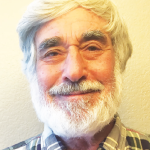

Have you ever considered what it might feel like to turn 100 years old? Robert Cabot has, now that his 100th birthday is only a month away.
Capturing Robert’s life in a PRT article is a lot to ask. As he says, “There are many things that can happen in a life that lasts 100 years!”
Fortunately, Robert published a memoir in 2019, ‘Time’s Up: A Memoir of America’s 20th Century,’ that includes descriptions of his time in the Army as a private during World War II, his graduation from Yale Law School, and his work for the U.S. Government. Robert spent time in D.C. during the Truman and Eisenhower administrations; lived in Europe working on the Marshall Plan that helped rebuild a shattered world after World War II; and worked on many aid projects in Asia.
Robert’s focus shifted from government service to writing in the late 1960s. His first novel, ‘The Joshua Tree,’ was published in 1970, with later editions following in 1988, 1991, and 2011. He sailed solo across the Atlantic in his 30-foot sloop in 1976. He and his wife Penny founded an intentional community on Cortez Island, British Columbia in 1978. Throughout this time Penny and Robert raised their three children. In total, they have six children, nine grandchildren, and four great-grandchildren.
As he closes in on 100, Robert both embraces and fumes about this latest chapter of his life.
On the fuming side, Robert sees his world becoming more limited, his attention span shortening, and his body less reliable. He may start a sentence and momentarily forget the words to finish it. He is more dependent on Penny than he would like to be, for her and for himself. Robert is not a believer in the afterlife, but these days he admits he does spend a lot of time wondering what it will be like to die. “I am slipping away slowly, but grateful that my basic mind is still working.”
“When I look back there are a few things that stand out,” he said. “The first is the writing. There are four novels now and a memoir. The last novel, ‘The Mango Tree,’ should be released in a few weeks.
“In my novels, I have been my most intricate, often complicated, often sad self, but always reaching for the beauty of life. My sister once complained that there were few verbs in ‘The Joshua Tree.’ I responded that it makes my writing more private, more alive. I never know exactly what I am going to write before I start writing. In the end, my novels are all somewhat autobiographical.
“The second is that I have spent a good part of my life rebelling against my privileged upbringing. It has shaped, hopefully in a positive way, my choices.”
(While there is evidence aplenty, Robert would never broadcast that he has consistently made choices that acknowledge and address social injustices. But we are his friends and we would acknowledge Robert’s actions. Philanthropy does much to better balance the scales of social justice. He is still working at it.)
“The third is that my 100 years is really split in half: my life before Penny and then my life with Penny. I am so very grateful for all of it, but especially the second half! What a deal!”
“My body, mind, and heart now occupy a quieter space,” he said. “My number one job is to see beauty. It is all around us despite our concerns about our fractured world. I am not optimistic about the future of humans on the planet. But for now, I am happy to be in this truly amazing community of Patagonia.”